Saturday, August 8, 2015

Check out this delightful 400 years of hats in 3 minute on YouTube

https://m.youtube.com/watch?v=Y9FzD7Bfy6g


Below is a little more detail on some of  today's popular hat styles.


Bowler/Derby/Coke

The Coke, more commonly known as the Bowler, was created at James Lock in 1850 for William Coke, a progressive farmer from Holkham in Norfolk. It was a domed hat, hardened by the application of shellac, devised to protect the heads of gamekeepers from overhanging branches of trees, and closely fitting the head so that it would not easily blow or fall off. The prototype was made by Thomas and William Bowler, hat makers in Southwark. It was brought to St. James’s Street to be tested by William Coke himself. This he did by jumping on it and as it withstood his weight he bought it.
At the shop this masterpiece was naturally identified as a ‘Coke’, but later when it went into production at the rate of sixty thousand a year, it became generally known as a ‘Bowler’, after its maker. In America it became a ‘Derby’ from its association with that famous horse race.
SCALA CLASSICO BOWLER STYLE # WF506-BLK


Straw Boater aka Skimmer

The origins of today’s boater are the sailor’s hat issued to midshipmen in the Royal Navy near the end of the nineteenth century. They were not as stiff as the modern boater but provided protection from tropical sun.
These hats were adopted by children in Victorian England and became part of their school uniforms wearing their school or house colours as bands.
The boater became a popular form of summer head wear for gentlemen as a lighter and cooler alternative to the bowler. For a while they also became popular with costermongers in the East End of London but today they are a rare sight, as it has been eclipsed by the Panama, and are mainly seen as part of the summer social scene at Henley Royal Regatta.
SCALA PANAMA BOATER P369-NAT
Here we have a shellacked braided Laichow boater.
SCALA CLASSICO SEWN LAICHOW BRAID BOATER MS369.


Trilby aka snap brim fedora

The Trilby is named after the female heroine of a novel of the same name written by George du Maurier. The novel was serialised in Harper’s New Monthly Magazine and was also made into a stage play. Trilby O’Ferral, the beautiful artist’s model who fell under the spell of Svengali, wore the soft indented felt hat in an 1895 dramatisation.
After the turn of the century the Trilby became more popular as men rejected the more formal stiff hats that were the vogue of the previous century. The Trilby was very much an American fashion but quickly spread to the rest of the world helped by the medium of film. It is also known as the snap-brim fedora.
SCALA SNAP BRIM FEDORA WF536

Fedora

The name “Fedora” comes from the heroine of French playwright Victorien Sardou’s drama presented in Paris in 1882. The hat soon became popular with men in the same way as the trilby.

SCALA CLASSICO FEDORA DF121

Panama

Panama hats are woven exclusively in Ecuador and are hand-woven from the Tequila Palm.
The origins of the hat go back to the 16th century when the Incas were the first to use the Tequila palm to make hats.
The term Panama comes from the number of workers building the Panama Canal who used the hat for protection against the sun.
In 1855, a Frenchman living in Ecuador took some samples to the World Exhibition in Paris and the finest quality panama was presented to Emperor Napoleon III.
Every Panama hat is unique as the making of the hats is a cottage industry and some of the finest panamas are made in Montecristi. The finest woven hats can take up to 6 months to weave and can command very high prices. The best hats have to be woven in the right conditions and humidity. The weavers split the fibre razor thin and plait ring after ring of palm fibre constantly dipping their finger tips into water.
The finest panamas have a very silky texture and when held up to the light you can see a spiral of rings together with the weaver’s signature. These rings are called ‘vueltas’ and the more there are determines the quality of the hat.
Panamas are exported from Ecuador in the form of hoods. These are then blocked by specialist hat factories into the two principal shapes which is the Fedora and the Safari.
The origin of the black band on the Panama dates back to 1901 when Queen Victoria died.
SCALA PANAMA BLOCKED IN THE USA P1230NAT
Panama hats are very popular with the ladies for summer 2015/2016.
CALLANAN LADIES PANAMA.

Top Hats

The top hat was originally a French invention and quickly became the status symbol for the nineteenth century gentleman and replaced the cocked tricorns (3 corners) and bicorns  (2 corners) that had been fashionable in the previous century.
The first top hats were made from beaver but a new material appeared called ‘hatter’s plush’ which is the trade’s term for what the public think of as silk. It was very fine silk shag, applied to the felt to give it a nap. The first man who was credited with wearing this new creation in London, the hatter John Hetherington, nearly caused a riot and was arrested for wearing a hat that was ‘calculated to frighten timid people’ (St James’s Gazette).
After this poor start the top hat soon became the conventional head wear for gentleman in Britain, Europe and the United States. It was seen as a symbol of wealth and social standing and able to enhance the wearer by making them seem taller, more refined and handsome. It is impossible to do manual labor while wearing this hat ,so it was worn exclusively as a status symbol.
SCALA CLASSICO 7" WOOL TOP HAT
SCALA CLASSICO 5 1/4" WOOL FELT TOP HAT

Back in France a Monsieur Gibus had invented a collapsible top hat known as the chapeau claque. This made storage much easier and could be easily placed under the seat of an opera house which gave the hat the name “opera hat” or the wearer could hold it under his arm giving the hat a third name “chapeau bras” (arm hat).
Today top hats are still worn all over the world at weddings and if you are invited to the Royal Enclosure at the Royal Ascot race meeting gentleman must be wearing either a grey or black top hat.

Mad as a Hatter
Mad hatters disease was a physical disorder that affected the nervous system and was caused by inhaling toxic fumes from mercury nitrate, a chemical used in the felting process. As well as the damage caused to the lungs the fumes affected the brain which led to paralysis, loss of memory, mental derangement and eventual death.
The symptoms were also recognized in the United States where the condition was known as the ‘Danbury Shakes’ after the town in Connecticut that was the centre of top hat manufacture.
As tragic as this was hat workers did not get much sympathy and victims of the condition were mocked in the nineteenth century and treated as drunkards (although hat workers were notorious for quenching their thirst caused by the dust and fumes of their occupation).
The term ‘Mad as a Hatter’ was made famous by Lewis Carroll in his novel Alice’s Adventures in Wonderland which was published in 1865 a year after the Factory Act of 1864 was passed, which among other things, required proper ventilation in workshops.
In the scene where the Hatter is being tried by the King, the King notices that the Hatter looks uneasy and anxious, and trembles so that he took both his shoes off – “Don’t be nervous”, said the King, “or I’ll have you executed on the spot!” Carroll describes here the symptoms of a sufferer in the first stages of the disease.

Monday, July 27, 2015

MAGIC moment at LAS VEGAS

 Once again, it is time to make your wholesale appointments for MAGIC, WWD, PROJECT and all the shows in Las Vegas AUGUST 17-19 2015. As the largest, in stock, hat company in the USA, we have many booths at the different shows.

Where the HAT action is, in LAS VEGAS

I will be splitting myself between WWD/MAGIC/PROJECT.
CALLANAN HATS will be at the WWD and the PROJECT booths.


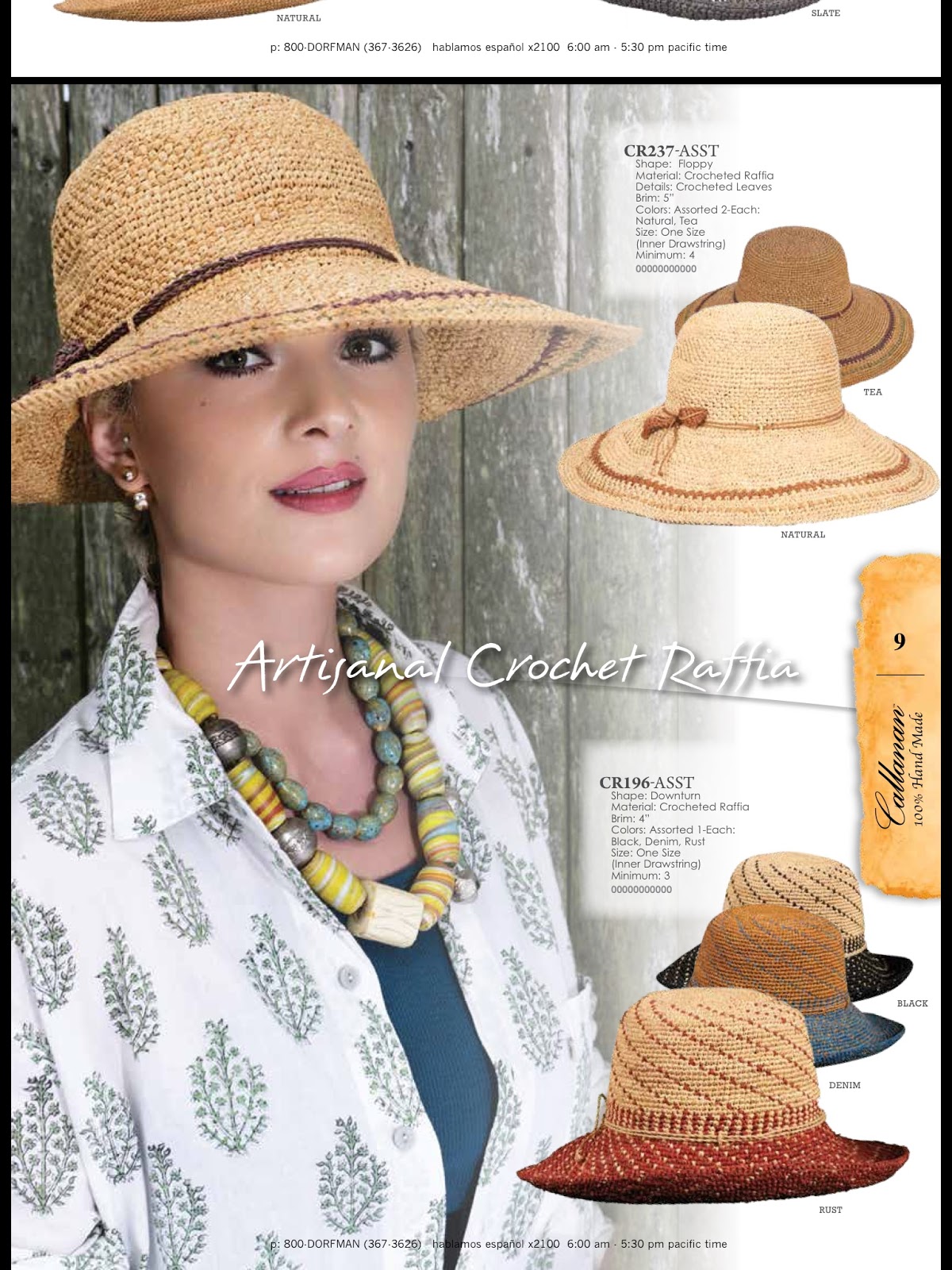
Make sure to meet our new CAPPELLI STRAWORLD designer Lucy Sanchinelli at our main Ladies booth WWD, where we show SCALA, CALLANAN and CAPPELLI straworld.


Come by and check out these NEW best sellers!!

CR253-asst


CR243-ASST-CORAL. ARTISANAL HAND CROCHETED RAFFIA

CR255-asst-navy

Wednesday, July 22, 2015

CALLANAN S2016, 17TH ANNIVERSARY COLLECTION FOR DORFMAN PACIFIC HAT COMPANY

Here at CALLANAN hats, we do not design hats in anticipation of attracting an audience. We know our audience, and we design with HER in mind.
We are proud to introduce or 17th anniversary CALLANAN collection for Dorfman Pacific Hat Company.


Sunday, July 19, 2015

A FEATHER IN YOUR CAP;THE DARK SIDE OF MILLINERY.

Another great hat article from NPR.

Hats Off To Women Who Saved The Birds

Woman wearing a "Chanticleer" hat made of bird feathers, circa 1912.
Library of Congress
The battle over the commercial trade in bird feathers in the late 19th and early 20th centuries "was one of the first times we saw a popular movement coalesce in defense of the environment, and not surprisingly it was to save birds," says Brigid McCormack, executive director of Audubon California and vice president of the National Audubon Society.
American fashionistas were in a frenzy over feather hats. Haute headwear made from real bird plumage was seen everywhere. The delirium was so widespread, in fact, that by 1886, writes Douglas Brinkley in The Wilderness Warrior: Theodore Roosevelt and the Crusade for America, "more than 5 million birds were being massacred yearly to satisfy the booming North American millinery trade. Along Manhattan's Ladies' Mile — the principal shopping district, centered on Broadway and Twenty-Third Street — retail stores sold the feathers of snowy egrets, white ibises, and great blue herons."
He continues, "Dense bird colonies were being wiped out in Florida so that women of the 'private carriage crowd' could make a fashion statement by shopping for aigrettes. Some women even wanted a stuffed owl head on their bonnets and a full hummingbird wrapped in bejeweled vegetation as a brooch."
Woman in a feather hat.i
Woman in a feather hat.
Courtesy of National Audubon Society
The statistics were staggering. Good Housekeepingreported in its winter of 1886-1887 issue: "At Cape Cod, 40,000 terns have been killed in one season by a single agent of the hat trade." On Cobb's Island along the Virginia Coast, an "enterprising" New York businesswoman bagged 40,000 seabirds —at 40 cents apiece — to meet the demands of a single hat-maker. The magazine questioned the sense — and sensibilities — of such inhumane behavior.
"Humanitarians and reformers may labor to save the birds," observed the Norfolk Virginian on Sept. 29, 1897, "but these labor in vain and will so long as fashion says to womankind wear wings, and mirrors tell the fact, fatal to birds, that feathers are becoming."
Not everyone, however, was so bird-thirsty.
Ruffled Feathers
By the late 1890s, women conservationists around the country were rallying to protect America's birds. Like a confusing fall warbler, the national debate darted back and forth — lighting on the women of nature and the nature of women.
In Boston, socialites Harriet Lawrence Hemenway and Minna B. Hall staged tea parties to inform their rich friends that birds were disappearing at an alarming clip, William Souder writes in the March 2013 Smithsonian Magazine. He quoted Hall: "We sent out circulars," Hall later recalled, "asking the women to join a society for the protection of birds, especially the egret. Some women joined and some who preferred to wear feathers would not join."
Woman in a bird hat.i
Woman in a bird hat.
Courtesy of National Audubon Society
Souder goes on: "Buoyed by their success—some 900 women joined this upper-crust boycott—Hemenway and Hall that same year organized the Massachusetts Audubon Society. Audubon societies formed in more than a dozen states; their federation would eventually be called the National Audubon Society."
The Chicago Daily Tribune of Oct. 24, 1897, asked women to save wild birds from extinction by pledging that "they would not wear birds or bird plumage of any kind except ostrich plumes on their hats." Ostrich plumes, the editor explained, can be gathered without torturing or killing the bird.
Such solidarity, the report noted, had forced one large Chicago mercantile company to stop using "the plumage of song birds in trimming hats."
Sara A. Hubbard, director of the Illinois Audubon Society, told the paper: "I expect to live to see the time when the wearing of bird plumage will be a brand of ignorance."
Other voices across the nation joined the chorus. "Protect the Birds," intoned the Indianapolis, Ind., News in a display ad on April 1, 1902. A clipped coupon and a penny could be exchanged for a Meadow Lark Audubon Society button.
American actress Lillian Russell, in a feather hat, 1898.i
American actress Lillian Russell, in a feather hat, 1898.
Library of Congress
In 1903, Brinkley writes, President Roosevelt signed an executive order protecting Pelican Island in Florida as a federal bird reservation, the first of many.
And the Greensboro, N.C., Patriot on April 15, 1908, underscored the importance of federal protection for songbirds.
Greed Vs. Grebe
Contemporary women were showing strength in many ways, wrote Minnie Moore Wilson in the April 27, 1912, Forest and Stream. If only "all the well-to-do women in America would absolutely stop wearing feathers in their hats tomorrow."
Pressure on the millinery industry intensified. Protests by Audubon societies and other bird-lovers were mounted, and state and federal laws — such as the Lacey Act of 1900 and the Weeks-McLean Act of 1913 — were passed.
Despite the regulations, some hatmakers continued to fashion feathery creations. The Brooklyn Daily Eagle reported on Feb. 8, 1914 that Oregon hunters were making good money shooting hundreds of grebes a day for the breast feathers. Boxes of grebes were being sent to California factories labeled "coyote skins."
Eventually, the Migratory Bird Treaty Act of 1918 — which made it "unlawful to pursue, hunt, take, capture, kill, possess, sell, purchase, barter, import, export, or transport any migratory bird" — effectively put an end to the omnipresent bird and feather hats.
The Migratory Bird Treaty Act has been enhanced and expanded over the years. And now the U.S. Fish and Wildlife Service hopes to widen the law even more, Audubonreports, to protect birds from wind turbines and cellphone towers — the omnipresent fashions of today.

Friday, July 17, 2015

NICK FOUQUET- THE ANTI MILLINER AND REBEL HAT MAKER


A Hat Maker Beloved by Madonna, Sia and Gigi Hadid — and Bob Dylan, Too


Photo
The hat maker Nick Fouquet's flagship store in Venice, Calif.Credit Ashley Noelle
Los Angeles-based Nick Fouquet is in many ways the ultimate California dude — tall and lanky, with a shaggy blond mane that simply begs to have a hat put on it — but don’t call him a milliner. His approach to hat making is anything but traditional. “I’ve always wanted to do my own thing,” he says, “and it’s such a niche market and undervalued accessory. To me, hats are the pinnacle of elegance. I’m not here to reinvent them — but to do it with my twist; not over-the-top or dramatic, like a milliner might.”

Photo
Nick FouquetCredit Ashley Noelle
There’s almost a hint of disdain in Fouquet’s voice, in fact, when he says the “m” word. “There are maybe 30 people in America and 300 people in the world who know this trade,” he says. “When I started, a lot of hat makers were appalled that I would use fire, throw paint on a hat, distress the felt, reinvent shapes. And I was like, ‘You’re like, 80 years old, what do you know?'” Indeed, a Nick Fouquet hat captures a lived-in aesthetic that brings a much-needed breath of fresh air to the market; the designer’s signature detail is a strike-anywhere match tucked into each hat’s brim. “TSA at the airport is not a big fan when I roll through with the matchsticks,” he admits. “They get very suspicious.”
Now, about five years since he’s entered the hat business, Fouquet puts out two collections a year, has partnered with Colette and has a collaboration with Barneys New York planned for this fall, and has a celebrity following that includes Madonna, Pharrell, Bob Dylan, Carine Roitfeld, Gigi Hadid and Sia (who wore a Nick Fouquet hat to perform at the afterparty for the Calvin Klein men’s show in Milan last week). But commercial success and the glitz of celebrity endorsement notwithstanding, Fouquet sounds most excited when he talks about working with individual clients through his bespoke business. “The client always thinks of things that I would never think of, like, ‘Let’s put 100 feathers on the brim,'” he says. “We just get these ideas. And I’m not afraid to fall flat on my face.”
Though Fouquet hasn’t ruled out expanding his line in the future — “In the grand scheme of things, yeah, I see a bigger brand,” he says — for now, his focus remains singular. “It would be preemptive to get into shoes, bags or ready-to-wear at this point,” he says. “There’s so much more that I have to say with hats.”
$900-$3,000, available at the Nick Fouquet flagship at 853 Lincoln Boulevard, Venice, Calif., and at Barneys New York starting this fall, 

Be sure to check out his summer hat video regarding genuine PANAMA hats.


nickfouquet.com.

Sunday, July 5, 2015

The Bowler, The Gent, The Avenger, Mr. JOHN STEED.

An iconic BOWLER hat wearer passes away.

Patrick Macnee in silhouette
Patrick Macnee, who has died age 93, was indelibly associated with the bowler hat he wore as his character, gentleman secret agent, John Steed, in The Avengers. Patrick Macnee was synonymous with his character's trademark Savile Row suits, umbrella and, of course, his bowler hat. 
The hat wasn't just for show. It was, along with his sword-concealing umbrella, Steed's main weapon of choice and was regularly lobbed at villains. Lined with chain mail, at various times it also served as a flashlight, a place to conceal a gun and even as a radio transmitter
It became - along with the catsuits of Steed's female assistants - the key visual motif of the show. In France, The Avengers was known as Chapeau melon et bottes de cuir - Bowler hat and leather boots.

null
Macnee with his third Avengers co-star, Linda Thorson

Macnee created Steed's distinctive look himself, He may have chosen the bowler hat as a symbol of quintessential, BRITISH GENTLEMAN, but its origins are more workmanlike.
The BOWLER HAT was made by the world's oldest milliner, Lock & Co, in 1850 as a form of protective head wear. Its original name was actually a Coke - named after the soldier and politician William Coke, who ordered the stiff felt hat to protect the heads of his gamekeepers who worked on his Norfolk farm, from low hanging tree branches, as they chased poachers, on horseback.
The prototype was made by Thomas and William Bowler, hat makers in Southwark, and brought to St James's Street to be tested by Coke himself. 
He did so by jumping on it and, because it withstood his weight, he bought it. The Coke became commonly known as a Bowler, after its makers. In America it became known as a Derby, after the horse race.

null
A London clerk sports a bowler in 1925

The bowler remained popular from its conception to around World War Two. Thereafter becoming "the hat" usually sported by City gents in London, before being reduced to something of a theatrical curiosity worn by Charlie Chaplin and Laurel and Hardy and of course the iconic Liza Minnelli as Sally Bowles in Cabaret.

null
A 1963 fashion shoot with his-and-hers bowler hats

But this headgear still has a wide range of fans and wearers today, for reasons both fashionable and traditional, from ex-boxer Chris Eubank to actor Jude Law, while other entertainers like Britney Spears, Ferne Cotton, and Daisy Lowe have picked up on the trend. 
The original illustrations of Sherlock Holmes often depicted him in a bowler whenever he was in London.

null
Chris Eubank in 2003 wearing a bowler

 The bowler hat is a symbol of middle class British respectability, it was also "something that manual laborers would wear for their Sunday best, becoming an aspirational item for them".

null
Malcolm McDowell as Alex in Stanley Kubrick's 1971 film A Clockwork Orange


null
Liza Minelli as Sally Bowles in Cabaret (1972)

The Bowler hat was recently used in the popular BBC series PEAKY BLINDERS, to give an air of respectability to Sam Neil's debauched character Inspector Chester Campbell.
But Bowler Hats also have a darker place in popular culture, thanks to their time perched atop the ultra-violent Droogs in Clockwork Orange, who assaulted people while wearing that headgear. It is also associated with Northern Ireland's Protestant orangemen, who also assault their Catholics neighbors, during their annual march.
"The bowler hat is associated with respectable, conventional living, so for those characters to wear them and commit those heinous crimes is morally transgressive," 
John Steed would have soon bowled those criminals over, no doubt. 
You can buy a classic bowler/derby hat from your local hat shop.
Just ask for a SCALA style # WF506-BLK, CHOCOLATE OR CHARCOAL